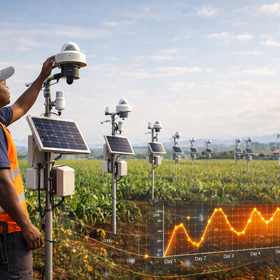
TAHMO Incoming Solar Radiation Prediction Challenge

'%3e%3cpath fill='%23001489' d='M0 0v6h9V0z'/%3e%3cpath fill='%23e03c31' d='M0 0v3h9V0z'/%3e%3cg stroke='%23fff' stroke-width='2'%3e%3cpath id='d' d='m0 0 4.5 3L0 6m4.5-3H9'/%3e%3cuse xlink:href='%23b' stroke='%23ffb81c' clip-path='url(%23c)'/%3e%3c/g%3e%3cuse xlink:href='%23d' fill='none' stroke='%23007749' stroke-width='1.2'/%3e%3c/g%3e%3c/svg%3e)
Huge congratulations to everyone who took part in this competition. It garnered a huge amount of interest and participation from the community, and we're excited to share the results!
📊 By the numbers:
- 1,529 participants enrolled
- 838 participants made a submission
- 16,860 total submissions
- Participants from 123 countries, 43 of them in Africa
Solar radiation forecasting like this feeds directly into renewable energy planning, irrigation scheduling, and climate resilience models across the continent—so thank you for putting your skills towards a problem that matters.
🏆 The Winners
🥇 1st place — Brainiac (Darius Moruri 🇰🇪)
🥈 2nd place — Paul_K (Paul Kamau 🇰🇪)
🥉 3rd place — iorana (Oleg Polivin)
A note on eligibility: A few participants who finished in the top 20 did not submit their code for review despite being prompted and were therefore disqualified from receiving prizes.
✅ How solutions were reviewed
Before prizes were finalised, every top-ranking submission went through a multi-stage review:
- Data and reproducibility check — confirming that the submitted code reproduced the submitted predictions.
- Similarity analysis — cross-checking all finalist submissions against one another (and against the pool of downloaded public submissions) to screen for irregular overlap.
- Pipeline review — a technical assessment of each solution's modelling approach, cross-validation design, and use of external data to evaluate genuine model quality rather than leaderboard position alone.
- Leaderboard probing was also taken into account during the review. Several submissions derived a meaningful proportion of their public score from repeated leaderboard feedback rather than genuinely generalisable modelling, and this was considered when assessing solution quality and determining the final rankings.
🔍 How they did it
🥇 Brainiac took a physics-first approach, engineering more than 500 features from 11 external satellite and reanalysis sources, and predicting the Clear-Sky Index rather than raw solar radiation. The standout innovation was a per-station guarded blend between a station-specific LightGBM model and a global neural network with per-station embeddings, complemented by carefully justified physical corrections for four sensors with known hardware issues.
🥈 Paul_K built a three-model stacking ensemble (LightGBM + XGBoost + CatBoost) with a Ridge meta-learner, grounded in peer-reviewed sensor science. Features were explicitly designed around known failure modes of the ATMOS 41 sensor used at TAHMO stations.
🥉 iorana combined XGBoost, an LSTM, and a Transformer into a single ensemble, with a standout per-component out-of-fold bias correction using statistical shrinkage.
Thank you to every single person who took part in this competition🌍☀️
Happy coding!
Congratulations to all the winners. Good job 👏. Please winners or top participants if you don't mind sharing your solution for us to learn. That would be nice and well appreciated 👏
This is great. Congratulations.
Lovely seeing the Kenyan flag at the top. Take a bow to the two Kenyans and hearty congratulations to all the winners!
Sweet baby Jesus Crist people.. you let #1 leaderboard prober stay. It is incredibly shameless.. so let me post this here:
Your #1 finisher probed the leaderboard, knew exactly the per-station MBE to target, then obfuscated his code with 500 engineered features to align perfectly with the MBE.
It's maddening how you guys have been played.