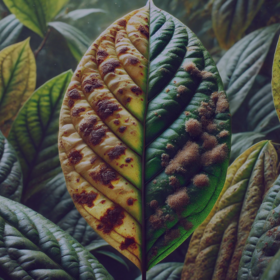
Amini Cocoa Contamination Challenge

'/%3e%3c/defs%3e%3cpath fill='%23fff' d='M-120-80h240V80h-240z'/%3e%3cpath d='M-120-80h240v48h-240z'/%3e%3cpath fill='%23060' d='M-120 32h240v48h-240z'/%3e%3cg id='b'%3e%3cuse xlink:href='%23a' stroke='%23000'/%3e%3cuse xlink:href='%23a' fill='%23fff'/%3e%3c/g%3e%3cuse xlink:href='%23b' transform='scale(-1 1)'/%3e%3cpath fill='%23b00' d='M-120-24v48h101c3 8 13 24 19 24s16-16 19-24h101v-48H19C16-32 6-48 0-48s-16 16-19 24z'/%3e%3cpath id='c' d='M19 24c3-8 5-16 5-24s-2-16-5-24c-3 8-5 16-5 24s2 16 5 24'/%3e%3cuse xlink:href='%23c' transform='scale(-1 1)'/%3e%3cg fill='%23fff'%3e%3cellipse rx='4' ry='6'/%3e%3cpath id='d' d='M1 5.85s4 8 4 21-4 21-4 21z'/%3e%3cuse xlink:href='%23d' transform='scale(-1)'/%3e%3cuse xlink:href='%23d' transform='scale(-1 1)'/%3e%3cuse xlink:href='%23d' transform='scale(1 -1)'/%3e%3c/g%3e%3c/svg%3e)
Team: Brain Blend
By @koleshjr & @Sodiq_Babawale_
The Amini Cocoa Contamination Challenge tasked participants with developing machine learning models capable of identifying multiple plant diseases from images of cocoa leaves. But there was a catch: these models needed to run on low-resource smartphones typically used by subsistence farmers in Africa without sacrificing accuracy.
As Team Brain Blend, we built a lightweight, robust pipeline using YOLO11s and ranked 3rd overall. Here's how we did it 👇
🧠 Challenge Overview
- Goal: Detect all visible diseases on cocoa leaves.
- Core constraints: Must generalize to unseen disease types. Must perform inference on low-resource smartphones.
The challenge was a blend of computer vision, model efficiency, and practical deployment something we were genuinely excited to tackle.
🔄 ETL & Data Pipeline
We started by organizing the provided dataset using a stratified cross-validation approach:
- 10-fold StratifiedGroupKFold to preserve class distribution and image-level grouping.
- For each fold, annotations and images were formatted into YOLO-compatible folder structures:images/train, images/val, labels/train, labels/val
This ensured each training round had a diverse and balanced dataset.
🧠 Modeling Approach
🧬 Model Choice: YOLO11s
We chose YOLO11s due to its speed, performance, and compatibility with edge devices. Its tiny size allowed us to meet the deployment constraint without compromising much on accuracy.
🔁 Training Strategy
We trained on folds 6, 7, and 8 of the dataset. For each fold:
- Validation was split: One half merged with training data. The other half used for model evaluation.
Each fold was trained for ~2 hours and 30 minutes, keeping us well within the 9-hour limit.
🧪 Inference Strategy
🧠 Ensemble Learning
We created an ensemble using Weighted Box Fusion (WBF) to combine predictions from all three models, improving robustness and detection confidence.
📐 Multi-Scale Inference
We performed inference across multiple image sizes to enhance generalization to unseen disease patterns:
[640, 800, 960, 1120, 1280, 1440]💡 Special thanks to @kiminya for inspiring the multi-scale strategy.
⏱ Runtime Summary
Training 8h 33min
Inference 40min
This made our solution fully compliant with the challenge's time constraints (≤9h training, ≤3h inference).
🧩 Model Interpretability
To understand what our models were actually looking at, we implemented EigenCAM:
- Extracts the first principal component of feature maps.
- Helps visualize attention regions related to disease classification.
Welldone @koleshjr. This is detailed. It was nice learning from you.
It was nice collaborating with you@Sodiq_Babawale_
Woah, we did similar things🔥. Thanks for sharing @Koleshjr @Sodiq_Babawale_
Yeah pretty much the same thing 😅, thanks
🔥🔥
Congratulations to Brain Blend team and thank you for sharing your solutions
Congrats guys. I also did the same thing with yolo11s, except that I trained 5 folds at a resolution of 448.
One important detail I noticed in your inference is that you set
max_det=600i.e., double the default of 300. Was this critical to final score? I noticed towards the end that subs with more detections scored a little better, but didn't pursue it further.
Not really , using the default leads to similar or slightly worse results.
In mine, it gives slightly worse results too. I feel the more the merrier works here.
@koleshjr Congratulations, your solution is insightful and thank you for sharing.
Thank you for sharing your detailed solution @koleshjr.
If I may ask, why did you choose folds 6,7,8 instead of other folds?
We were doing subsets of 3s since that is what was fitting in the set time limit, and that combination had the best local val scores and lb was not bad as well
Well done + thanks for sharing