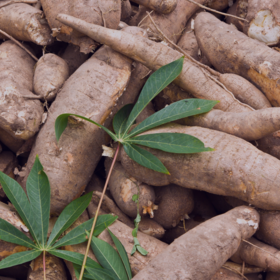
CGIAR Root Volume Estimation Challenge


In my opinion, the best solution should consider both images and tabular data for estimating root volume.
Quote 1:
"Estimating root volume should involve both left and right images, as they represent different parts of the full image. The full image can be segmented to identify individual plant roots before proceeding with volume estimation."
Quote 2:
"PlantNumber should mainly be used to verify segmentation results, as the first step is identifying different plants in an image. The Start and End values are just suggestions and not mandatory. No additional data beyond what is provided should be used in this challenge."
The competition instructions were clear. I acknowledge that the top 10 submissions were ranked based on leaderboard scores, and all participants optimized their models accordingly. I also implemented a meta model that utilized extracted features from by SAM model from different cassava parts based on PlantNumber, but it performed poorly.
There was debate about the best approach—whether to use only tabular data or incorporate images. Surprisingly, some of the top-performing models did not use images at all, even though this was a computer vision competition. This raises concerns about the competition design because:
- The tabular data alone contained enough predictive power, making images unnecessary.
- The image data introduced too much noise, making it harder to extract useful information.
- RMSE (Root Mean Squared Error) as the evaluation metric disproportionately penalized models using images, possibly due to segmentation errors or variations in image quality.
This contradicts the intent of a computer vision challenge, where image-based models should ideally perform better. A better approach could have been:
- Using Mean Absolute Error (MAE) instead of RMSE to balance error penalties.
- Ensuring image data contributed meaningfully through better preprocessing and validation.
- Encouraging models that actually use images, rather than allowing tabular-only solutions to dominate.
Overall, RMSE may not have been the best choice for this competition, as it unintentionally favored tabular-only approaches. This resulted in a misalignment between the competition's objective and the actual winning strategies.
My Oppinion