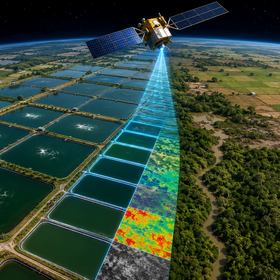
GeoAI Aquaculture Pond Identification Challenge by FAO and ITU
1000 CHF
~1 month left
Data Analysis
Classification
Feature Engineering
GIS
995 joined
344 active
Start
Jun 08, 26
Enrolments close
Aug 07, 26
Close
Aug 16, 26
Reveal
Aug 16, 26

'%3e%3ccircle r='20' fill='%23008'/%3e%3ccircle r='17.5' fill='%23fff'/%3e%3ccircle r='3.5' fill='%23008'/%3e%3cg id='d'%3e%3cg id='c'%3e%3cg id='b'%3e%3cg id='a' fill='%23008'%3e%3ccircle r='.875' transform='rotate(7.5 -8.75 133.5)'/%3e%3cpath d='M0 17.5.6 7 0 2l-.6 5L0 17.5z'/%3e%3c/g%3e%3cuse xlink:href='%23a' transform='rotate(15)'/%3e%3c/g%3e%3cuse xlink:href='%23b' transform='rotate(30)'/%3e%3c/g%3e%3cuse xlink:href='%23c' transform='rotate(60)'/%3e%3c/g%3e%3cuse xlink:href='%23d' transform='rotate(120)'/%3e%3cuse xlink:href='%23d' transform='rotate(-120)'/%3e%3c/g%3e%3c/svg%3e)
Tips for handling the temporal shift to improve LB score?
9 Jun 2026, 13:06 · 2
Hi everyone! I'm stuck around 0.953 on the leaderboard and can't seem to get past it, while many of you are at 0.98+. I'd really appreciate any general guidance (no need to share code):
- The challenge is about temporal generalization (train/test from different periods). What kind of features worked best for you to stay robust across seasons — raw monthly bands, time-aggregated stats, spectral indices (NDWI/MNDWI), or something else?
- Did you do any train/test distribution alignment or normalization to handle the time shift?
- Since threshold tuning is forbidden (fixed 0.5) and F1 is 60% of the score, did you do anything special for calibration / class weighting to optimize F1 at 0.5?
- Was a single model enough, or did ensembling make the difference?
Any hint on what gives the biggest jump would mean a lot. Thanks!
A few tips, maybe, from what I have so far realised.
I have had to focus first on validation. A random split can look very strong but fail badly here because the test set is from a different period/distribution. A grouped or spatial/temporal-style validation gave me a much better signal than random CV.
Feature-wise, the biggest value came from robust summaries rather than relying only on raw monthly bands. Raw Sentinel-1/2 monthly values help, but I found temporal aggregates, seasonal min/max/range/std, and water/vegetation indices like NDWI, MNDWI, NDVI-style features more stable. SAR ratios and simple texture/moisture proxies can also help. Though I have been careful with the coordinates or nearest-neighbour style features because they may overfit the public split.
For the 0.5 threshold issue, I have thought in terms of calibration during training rather than post-hoc threshold tuning. Class weighting, balanced objectives, probability calibration, and checking whether the positives count made a big difference for F1 at the fixed cutoff.
A single strong tree model for me did well, but an ensemble of different tree-based models usually gave more stable rankings. The biggest jump for me was better validation first, robust temporal/index features second, calibration/class balance third.
I hope this helps -;)
THANKS