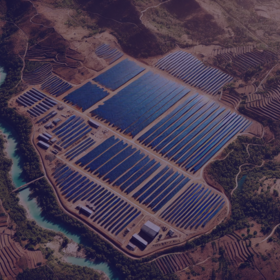
Lacuna Solar Survey Challenge


'/%3e%3cuse xlink:href='%23a' transform='rotate(23.036 .093 25.536)'/%3e%3cuse xlink:href='%23a' transform='rotate(45.87 1.273 16.18)'/%3e%3cuse xlink:href='%23a' transform='rotate(69.945 .996 12.078)'/%3e%3cuse xlink:href='%23a' transform='rotate(20.66 -19.689 31.932)'/%3e%3c/svg%3e)
Lacuna Solar Survey Challenge
Can you identify solar panels and boilers in satellite and drone imagery?
1.Dataset
1.1.Initial analysis revealed annotation flaws including:
· Polygon misalignment
· Partially omitted panels ("pans")
· Incorrect panel numbering ("pan_nbr")
1.2.We addressed these by:
· Converting polygon annotations to DOTA format
· Performing data cleaning and relabeling using LabelImg2 (custom fork with rotated box support), but we used CoCo format finally
2.Key Insight
2.1.Object detection (vs. direct regression) proves more effective for:
· Precise localization of solar panels/boilers
· Accurate counting in Madagascar's satellite/drone imagery
3.Data Preprocessing
3.1.Domain Separation Strategy:
· Original image sources D (4000×3000/5280×3920) and S (600×600) exhibit significantly different resolutions
· Model cannot learn cross-domain features effectively (risk of interference)
· Final approach: Train separate models for D and S domains
3.2.Data Filtering:
· Removed ambiguous images with mismatch between actual counts and annotated numbers
3.3.Data Split:
· Creating 2 or more folds and insuring that the distribution of val contains extreme values (pan_nbr > 100) with equal distribution
4.Model Selection on D
Model
Epochs
Performance Notes
YOLO11m (RTX 4080 16G)
300 (72 hours)
Baseline performance, ultimately discarded.
DDQ (2*T4 2*16G)
14 + 10 (24hours)
Optimal convergence & accuracy
Co DINO (A10G 24G)
14 (12 hours)
Optimal convergence & accuracy
4.1.Why DDQ and Co DINO Wins:
1. 10× faster convergence (24 epochs vs 300 epochs)
2. Superior performance on:
- Dense object clusters
- Small object detection (critical for satellite imagery)
- Occlusion handling
4.2. Training methods
We constructed two distinct datasets with strategic validation splits to address extreme-value distributions (panel numbers exceeding 100). Both datasets maintained balanced extreme-value representation across training and validation sets (train₁-val₁ and train₂-val₂). Independent models were trained on each configuration, with final predictions derived through ensembled outputs.
4.3. Data augmentation
· Random Horizontal/Vertical Flip: RandomFlip with probability 0.5.
· Color Jitter: ColorJitter with brightness/contrast/saturation (±20%) and hue (±10%) adjustments.
· CLAHE (Contrast-Limited Adaptive Histogram Equalization): Enhances contrast with clip limit 2.0 and grid size 8x8.
· Gaussian Blur: Blurs images with sigma range 0.1-2.0.
· Random Affine Transformations: Scaling: 0.9-1.1x/Translation: ±10% shift/Rotation: ±20 degrees.
· Random Brightness/Contrast: Adjusts brightness/contrast (±30%) with 30% probability.
· Image Sharpening: Sharpens edges with alpha 0.1-0.3 and lightness 0.75-1.5x.
· Multi-scale Pipeline:Resize to 1280x1280 (keep ratio)/Resize → Random0Crop (384x640) → Resize to 1280x1280.
4.4. Threshold Optimization Strategy
For images containing a high density of solar panels (defined as >100 panels per image in this study), we observed systematic under-detection due to overly conservative confidence thresholds.
We implemented a dual-phase adjustment:
1. Confidence thresholds tuning: Minimized MAE loss on the validation set for general threshold calibration.
2. High-density specialization: Empirically reduced the confidence threshold to 0.1 exclusively for images where preliminary detections exceeded 100 panels.
4.5. Location-Optimized Ensemble Strategy
Experimental analysis reveals varied model performance across installation locations. The complete DDQ architecture underperforms on rooftop imagery compared to alternative models. We therefore implement an adaptive weighting system that strategically combines model strengths by deployment position.
Ensemble weights were established through validation evaluation, with an exception: Fold 2 model's ambiguous validation performance prompted provisional low-weight assignment. Leaderboard validation confirmed this configuration's effectiveness, justifying its retention.
5.Model Selection on S
Model
Epochs
Performance Notes
YOLO11m (RTX 4080 16G)
300 (2 hours x 5 folds)
Baseline performance
5.1.Data augmentation:
· resize to 1024
· random rotate / multi_scale / translate / flip v,h / mosaic / mixup / cos_lr
· training on 5 folds
5.2.Test Time Augment
· Pan: SAHI get sliced prediction for 450x450 slice, considering the smaller size of pan
· Boil: multi_scales prediction on 876(1, 0.86, 1.3)
· Model ensemble to get mean pan_nbr and boil_nbr
Model
Epochs
Performance Notes
DINO (P100 16G)
37 (24hours)
Optimal convergence & accuracy
DDQ (P100 16G)
14 (12hours)
Optimal convergence & accuracy
5.3.Data augmentation:
· Multi-scale resizing
· Random horizontal flipping (50% probability)
· Color space normalization
· PhotoMetricDistortion (contrast/brightness/saturation/hue adjustments)
5.4.Weighted Ensemble Strategy
Blends DINO, DDQl, and YOLO results at different weight
6.Process:
 📷
📷7.Winning Edges:
- We recognized the poor annotation quality of the dataset and manually corrected and annotated them
- Instead of approaching it as a prediction task, we framed it as an object detection task, which enhanced accuracy and interpretability
- We selected powerful DETR-series models (DDQ, DINO), which significantly outperformed the YOLO-series models
- Multiple TTA, post-processing, ensemble strategies were employed to address various potential scenarios, achieving a lower MAE
Congratulations on the 1st Place. Thank you for the detailed write up, it's truly appreciated 👏
Hi WoWoGG,
Great work on your Lacuna Solar Survey solution! The DETR-based approach and ensemble strategies were particularly insightful.
Since the competition is over, could you share your notebook/code? It would be helpful.
Wow! Congratulations on your win. You truly deserved it. Thanks for your write up too. I initially also approached this as an object detection problem and even annotated a handful of images in the hope that I'd train a model and iteratively annotate the rest. but performance was not that great for me. I guess that the key insight here is not mixing drone and satellite data.
Wow, this involves a lot of work. You really deserve the first place. Writing this blog on medium will be great. It is well detailed. Thank you for sharing with us.
Congratulations on your top win! Enjoyed reading your solution write-up. Very detailed and insightful.
Impressive work!
Hey @WoWoGG, first of all congratulations on winning. I have one question on the data side. During relabelling, did you try labeling each panel individually? For eg: if there was one polygon provided in the zindi data which contained 10 panels, did you draw 10 polygons over there by manually assessing the extent of the panels?